Your next R&D milestone starts with better evidence.

From disease research to diagnostic development, BioBuild provides the bioinformatics expertise, tailored analyses, and reproducible results needed to turn complex biological data into actionable insights.

biobuild · workspace

  • Pull cohort from GEO + internal storeGSE-neuro · n=42 · checksum verified
  • Normalize & run differential expressionDESeq2 v1.42 · params logged
  • Flag candidate biomarkers & plotFDR < 0.05 · figure_3.svg
Provenance sealed sha256:9f3c…a71b

BioBuild / Client work

Working with teams across life sciences

BioBuild turns complex biological data into results that guide the next R&D decision.

Using assay data and machine learning to guide diagnostic development

Astek needed to understand what its plate-reader data could reveal about rapid urinary tract infection testing and which approaches deserved further development.

Explore the story

01 / Astek Diagnostics

The challenge

Astek needed to understand what its plate-reader data could reveal about rapid urinary tract infection testing and which approaches deserved further development.

How we helped

BioBuild analyzed the experimental data and developed machine learning models to investigate patterns in the measurements. We compared findings against available reference measurements and assessed where further evidence was needed.

What the team gained

The results helped Astek prioritize analytical directions and design follow-up experiments to test the remaining questions.

Using single-cell data to guide neuroimmune research

Researchers wanted to understand how chronic stress affects microglial populations and gene activity, and use those findings to focus their next experiments.

Explore the story

02 / Johns Hopkins School of Medicine

The challenge

Researchers wanted to understand how chronic stress affects microglial populations and gene activity, and use those findings to focus their next experiments.

How we helped

BioBuild analyzed single-cell data, annotated cell populations and compared gene-expression patterns across conditions. We tested biological hypotheses and interpreted the findings alongside the team’s research questions.

What the collaboration established

The results helped the researchers prioritize hypotheses and design follow-up studies.

Abstract illustration of cells

Connecting preclinical data to development decisions

An oncology team needed to evaluate potential targets and indications using evidence from efficacy studies, immune-response experiments and molecular profiling.

Explore the story

03 / Emerging Oncology Company

The challenge

An oncology team needed to evaluate potential targets and indications using evidence from efficacy studies, immune-response experiments and molecular profiling.

How we helped

BioBuild analyzed the datasets, tested the team’s hypotheses and brought the results together to assess candidate development directions and identify unanswered questions.

What the team gained

The findings helped the team prioritize hypotheses and design follow-up studies to support its next development decision.

Who we work with

Bring the data your instruments produce.

Assay developers, clinical-stage biotechs, discovery teams, CROs and core facilities. Pick the one closest to you. The lists are examples, not limits.

Tell us what you have

Typical asks

Detection limits and repeatability for a regulatory file, concordance with a reference platform, lot-to-lot drift.

Data we typically receive

  • Multiplex immunoassay panelsLuminexMSD
  • Affinity proteomicsOlink NPXSomaScan ADAT
  • Targeted sequencing panelsFASTQBAMVCF
  • qPCR and ddPCRCt tablesRDML
  • Detection limit and repeatability studiesCLSI EP17EP05
  • Cross-platform concordanceBland-AltmanLin’s CCC

Not listed? Most of what we receive isn’t. Send the format and the question.

Biological insights

Uncovering the biology behind the numbers.

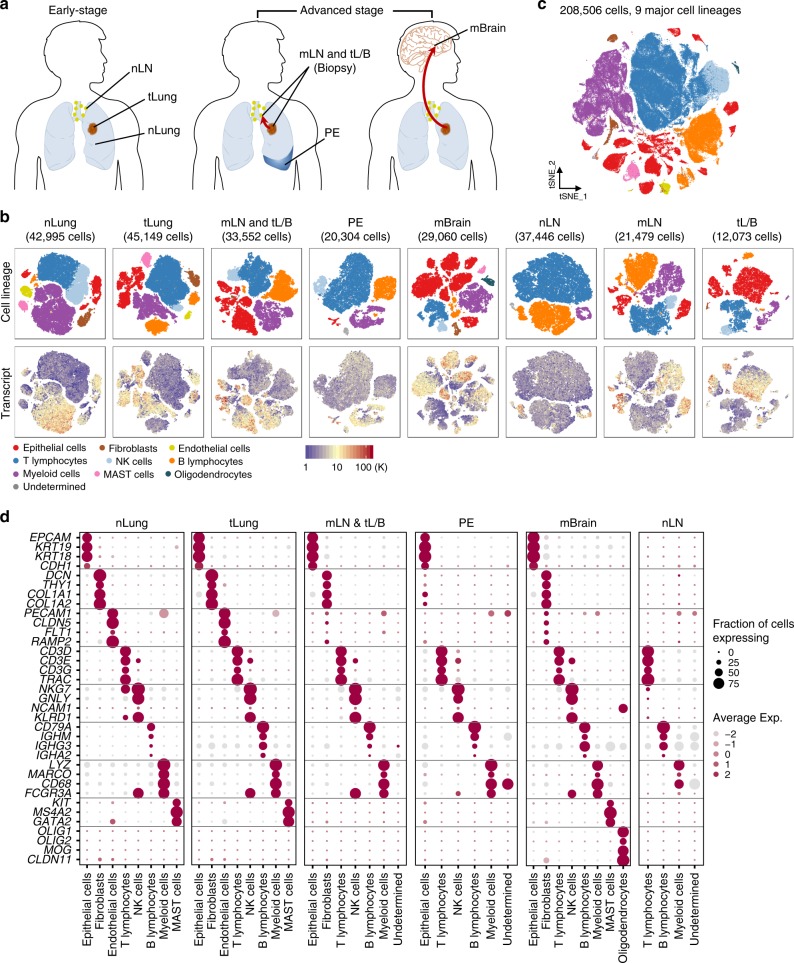
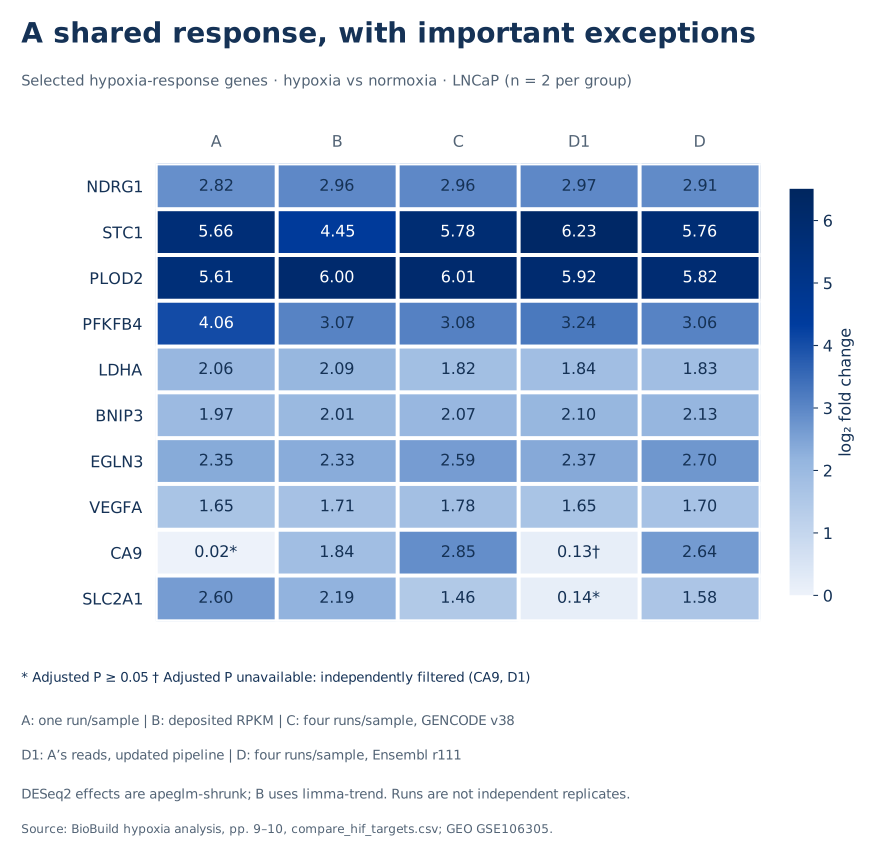
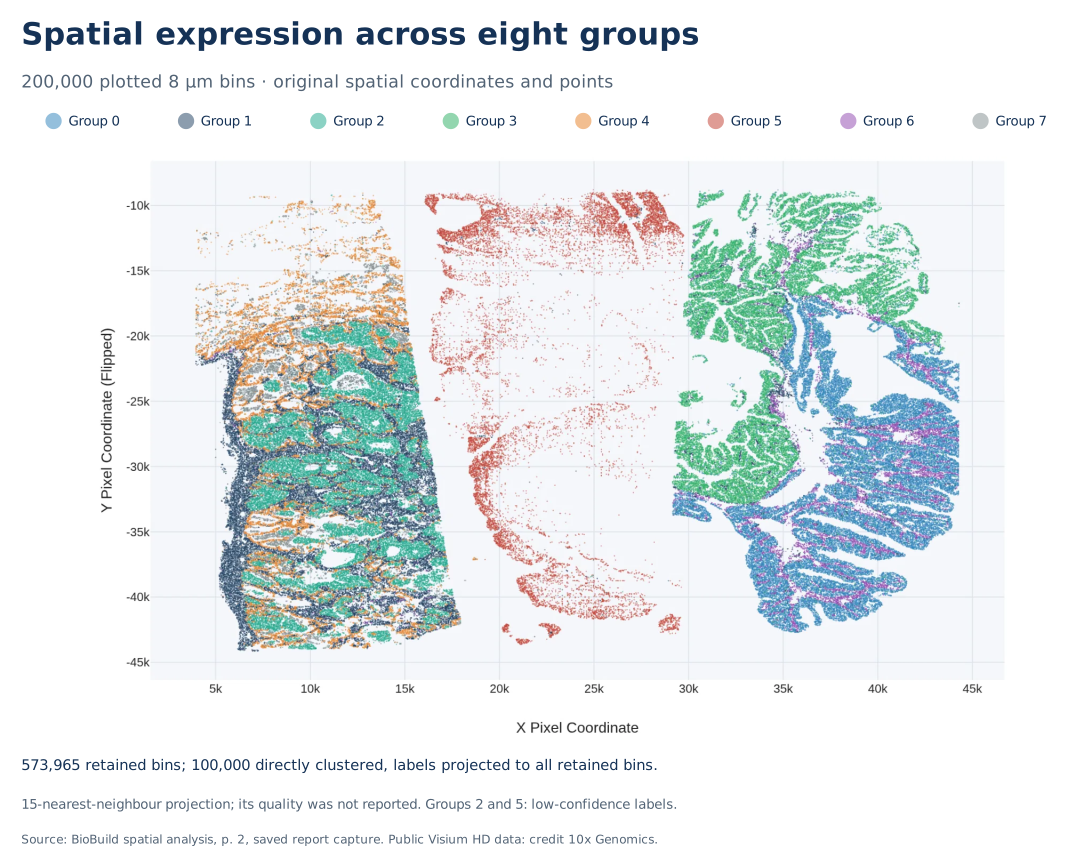
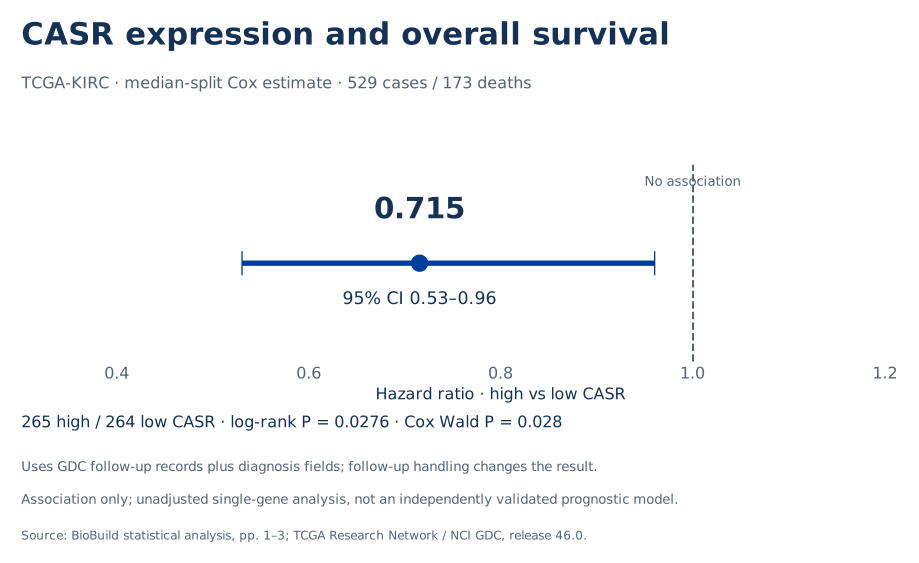
We start with the biological question and shape the analysis around the evidence needed to investigate it. These examples show how we use tissue context, findings across studies and cell identity to understand biological signals in published data.

biobuild · analysis explorerRecorded example
Research question

Where do injury and macrophage-associated signals appear in kidney tissue, and how do their spatial patterns differ between the sampled conditions?

GSE269622 · 10x Visium · Sham, AKI 4 h and AKI 12 h

Study setup · acute kidney injury
ShamControl section
4 hoursEarly injury
12 hoursAcute response
Visium tissue sections → spatial gene-expression data

Original schematic of the analysed subset: one section per condition. Kidney drawings are condition schematics, not histology. Based on Xuanyuan et al. (2025); the published study includes additional timepoints and Xenium profiling.

Example requests summarise the reviewed studies. This walkthrough displays recorded results; it does not run a new analysis.

Original case-report figure

What you get when you hand us a dataset.

Each case starts with a question a research team would bring us. We run the analysis end to end to uncover deeper insights and reliable findings. See how those results can shape your next study and guide your next R&D milestone.

The four case studies use public datasets to show our methods. They are not client results, clinical products or experimental validation.

Technical details

BioBuild plans the analysis, runs real code on your data and checks its own numbers. You approve the plan first, and every result links back to the step that produced it.

Human scientist

Sets the question, approves the plan, and signs off on every result.

Your data

Sequencing, imaging and tabular files you upload

Public databases

NCBI, Ensembl, UniProt, gnomAD and 5 more

Literature and web

Search results the agent reads and cites

BioBuild agent Running
  1. PlanDrafts the analysis plan and waits for your approval before any code runs.
  2. Skills36 domain skill packs: single-cell, proteomics, CRISPR, metagenomics and 32 more.
  3. ExecuteRuns the code in an isolated cloud sandbox with your files mounted.
  4. VerifyRecords every reported number with its source file and the script that computed it.
Report

Findings with figures, tables and citations

Figures and data

Every file a run produced, ready to download

Capsule

A re-runnable record of each step, its inputs and its environment

Who we help

CRO teams

Add specialist analysis capacity to your next study.

Scope a defined analytical workstream with BioBuild, from data review through figures, interpretation, and a documented handoff. Align the outputs with your study question and client reporting needs.

Scope your study analysis

Biotech teams

Get the readout your next program decision needs.

Bring the data you already have and the decision it needs to inform. We help assess the findings, prioritize follow-up, and prepare an analysis package your team can examine and build on.

Discuss your next readout

What does your data need to answer?

For CRO teams and lean biotech: bring your research question, existing data, and the decision behind your next milestone.

Discuss your analysis

Talk through your question, inputs, and desired outputs.